The quick version
- Katla caves are reached from Vík, and Jökulsárlón caves are reached from the lagoon below Vatnajökull.[1][2]
- Short jeep tours start from US$145 for a 3.5 hour Jökulsárlón departure and from US$182 for a 3 hour Katla tour from Vík.[3][4]
- Katla day tours from Reykjavík are listed at 10 to 12 hours, from US$275, with pickup included on both.[5][6]
- Jökulsárlón: Vatnajökull Ice Cave Guided Tour runs 3 hours from US$164, rated 4.25 from 2,171 reviews.[2]
- A natural ice cave in Vatnajökull forms in October, lasts through April and is taken back by meltwater in May.[7]
| Katla ice cave | Jökulsárlón ice cave | Katla day from Reykjavík | |
|---|---|---|---|
| Where it starts | From Vík[1] | At the Jökulsárlón lagoon[2] | In Reykjavík[5] |
| From price | from US$182[4] | from US$145[3] | from US$275[5] |
| Typical length | 3 hours[8] | 3 hours[2] | 10 hours[5] |
| Group cap | Limited to 14[1] | Limited to 8[9] | Limited to 14[6] |
| Rating | 4.68 from 1,500 reviews[8] | 4.25 from 2,171 reviews[2] | 4.66 from 745 reviews[5] |
An ice cave in Vatnajökull typically lasts one winter. The summer meltwater channel that shaped it drains and firms up in October, stabilises through November, holds its coldest and bluest form from December to February, ages through March and April, and is taken back by meltwater in May.
Katla or Jökulsárlón: which ice cave tour fits your trip?
Know this first
- Decide whether you want a short cave trip or a glacier walk with the cave as part of it.
- Allow a long day if you are driving to Jökulsárlón from Reykjavík, or stay overnight nearby.
- Check the cap on group size in the listing if you prefer a quieter cave.
- All prices on these listings are from-prices, so totals vary with your dates.
On the day
- A helmet is standard inside a cave and is generally provided by the operator.[10]
- Wear waterproof outer layers over warm mid layers; caves are damp and cold.
- Bring boots with grip you can walk uphill in, plus a spare pair of gloves.
- Winter daylight is short, so aim for a tour slot in the middle of the day.
Katla or Jökulsárlón: how the two ice caves differ
Iceland's south coast has two well-known ice cave areas. One sits above the village of Vík, where super jeeps climb onto Mýrdalsjökull to reach the Katla caves.[6] The other sits under Vatnajökull, where tours leave from the Jökulsárlón lagoon and drive up onto the ice cap.[2] Both put you inside a cave carved by meltwater, with a helmet on your head and crampons under your boots. The things that decide your booking are the drive, the length of the trip and the price of the seat.
Vatnajökull is the bigger stage. The thickest point of the ice cap is 3,120 feet (950 m) deep, with an average thickness of 1,250 feet (380 m).[11] The lagoon at its edge is 248 meters (814 feet) deep and has quadrupled in size since the 1970s.[12] Katla's caves sit under Mýrdalsjökull, a smaller ice cap above the black sand plains east of Vík, and the approach from the village is short.
The Katla ice cave, reached from Vík
Katla tours leave from Vík, the south coast village under Mýrdalsjökull, and climb to the cave by super jeep.[1] A small group departure is listed from US$182, and the super jeep version from US$193.[1][4] One Vík tour is capped at 14 participants and rated 4.63 from 2,395 reviews.[1] Another is rated 4.35 from 1,038 reviews.[4] Inside, Katla ice often carries bands of dark volcanic ash, with the blue showing in stripes rather than as one clean block.
From Reykjavík, Katla usually comes as part of a south coast day. Those tours start from US$275 and run 10 to 12 hours, with stops at waterfalls, black sand beaches and the village of Vík along the way.[5][6] One of them caps at 14 participants.[6] Katla works as a single day from the capital, with pickup included on both departures.[5][6]
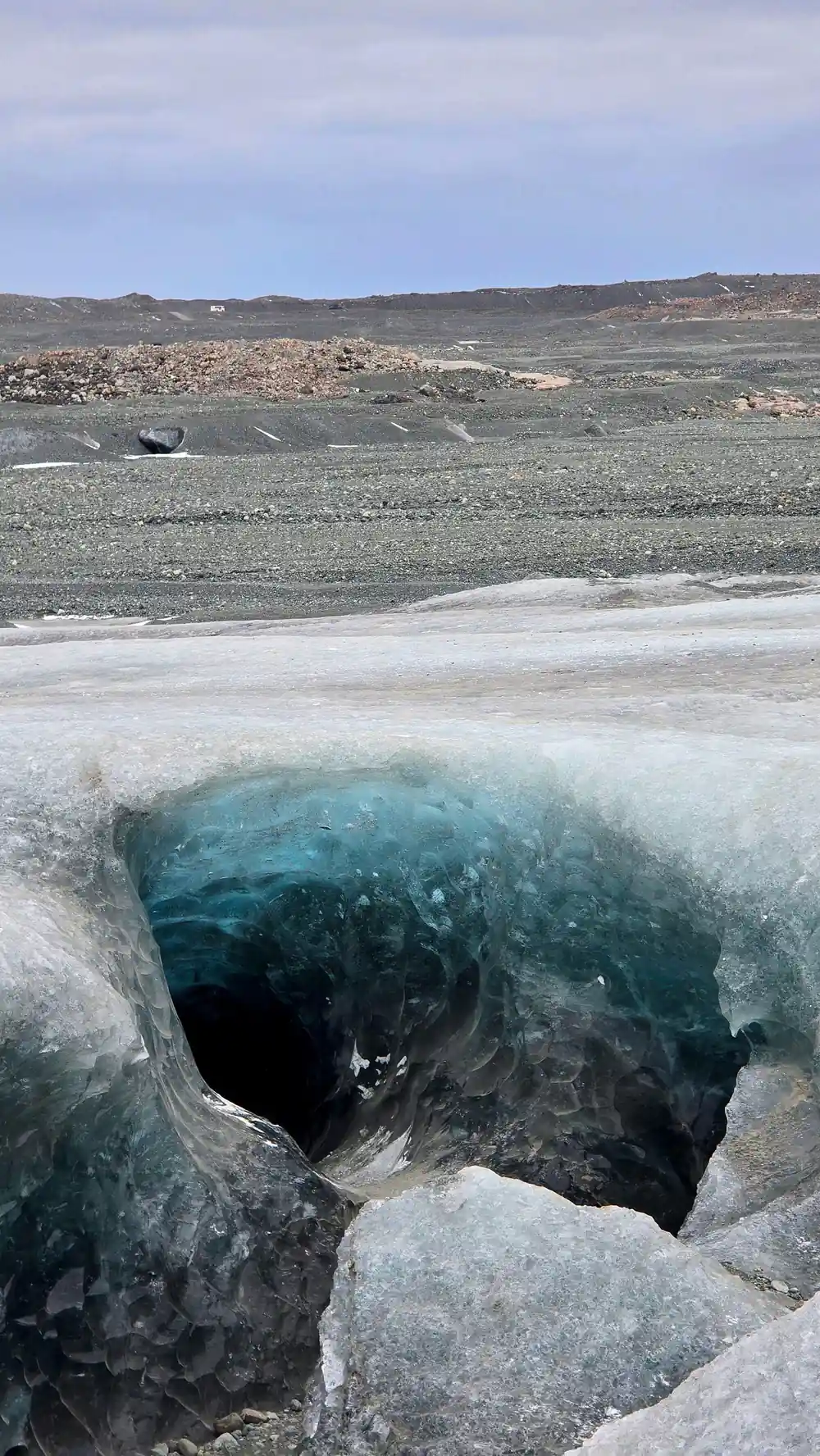
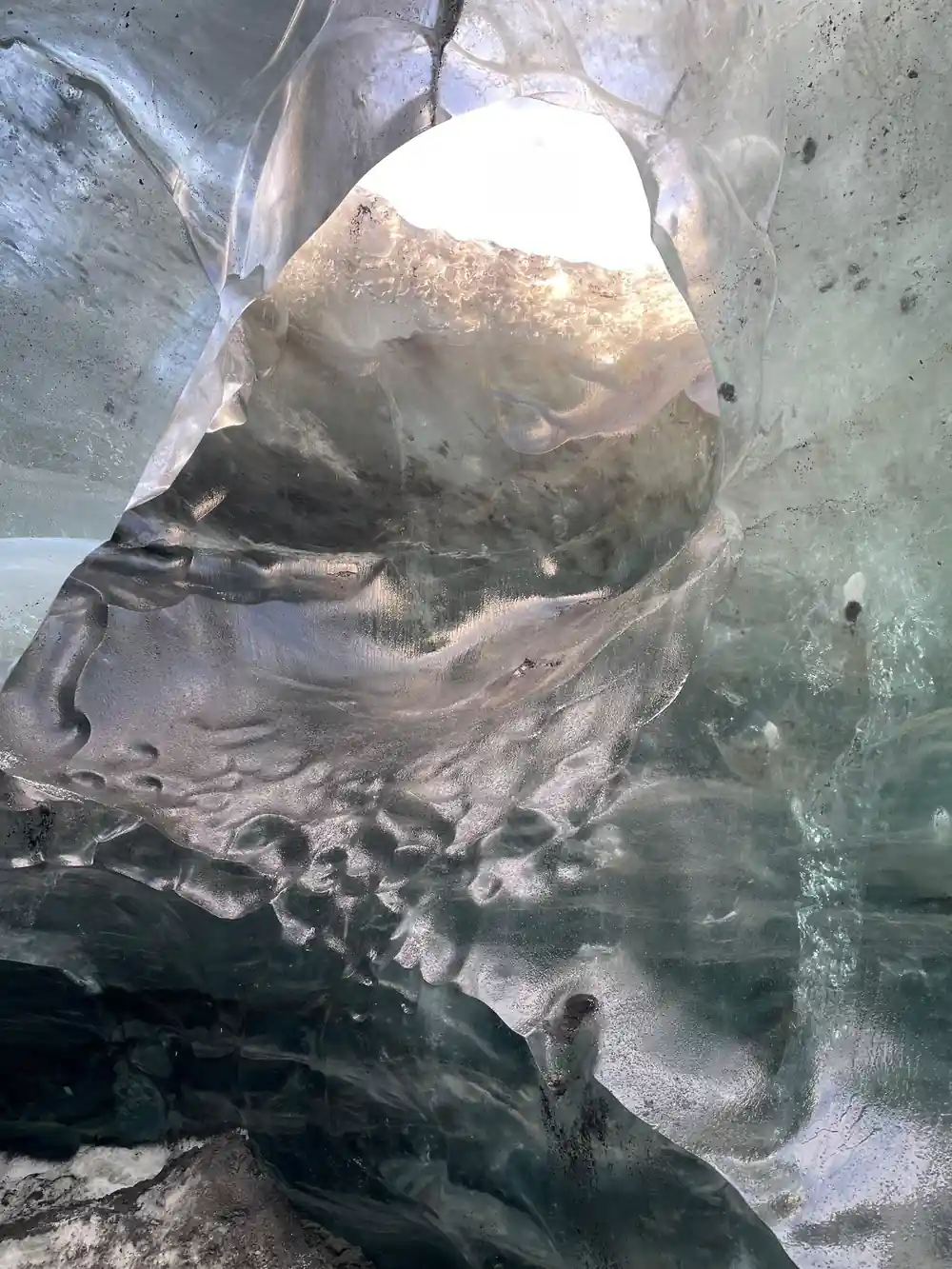
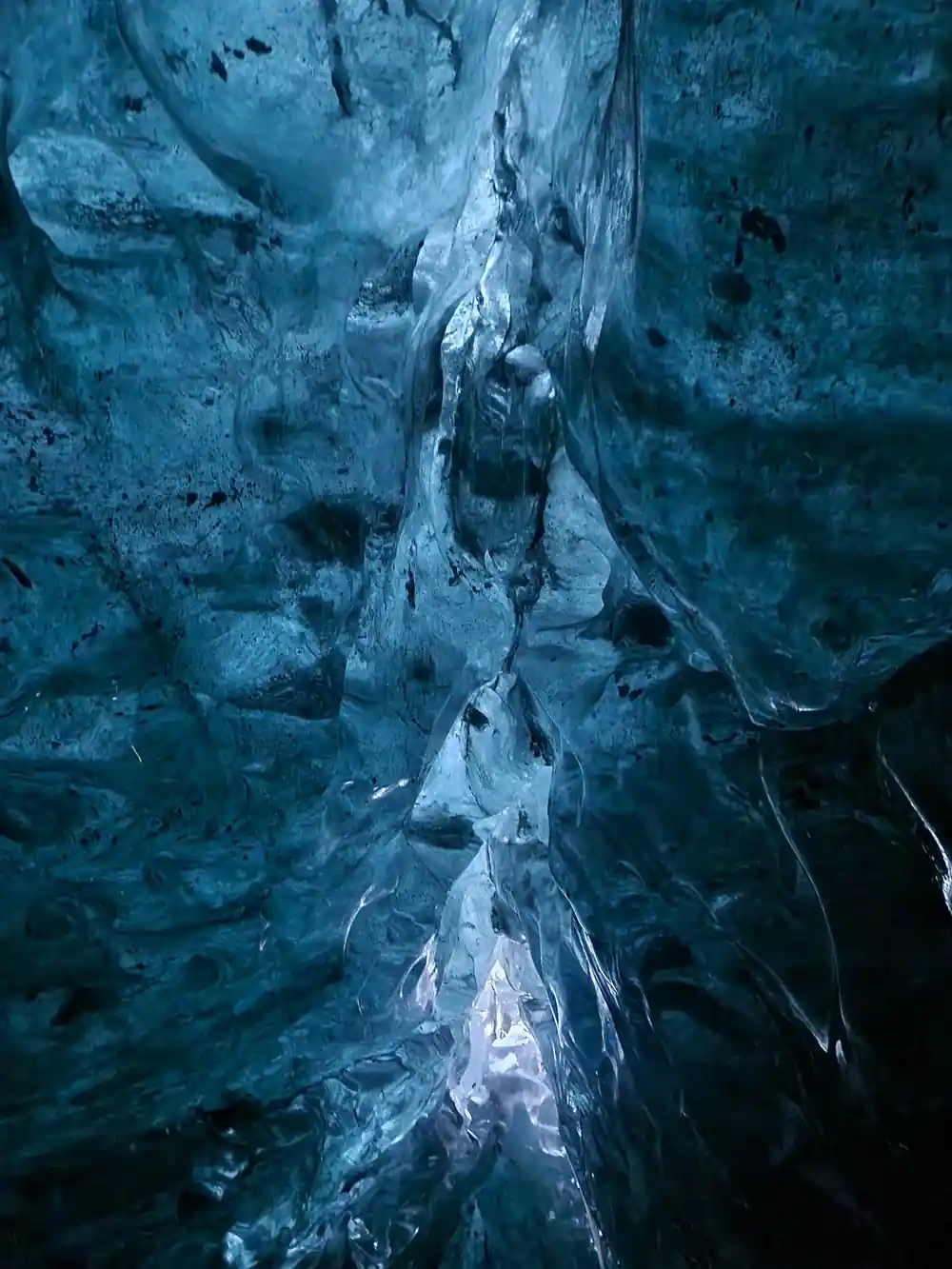
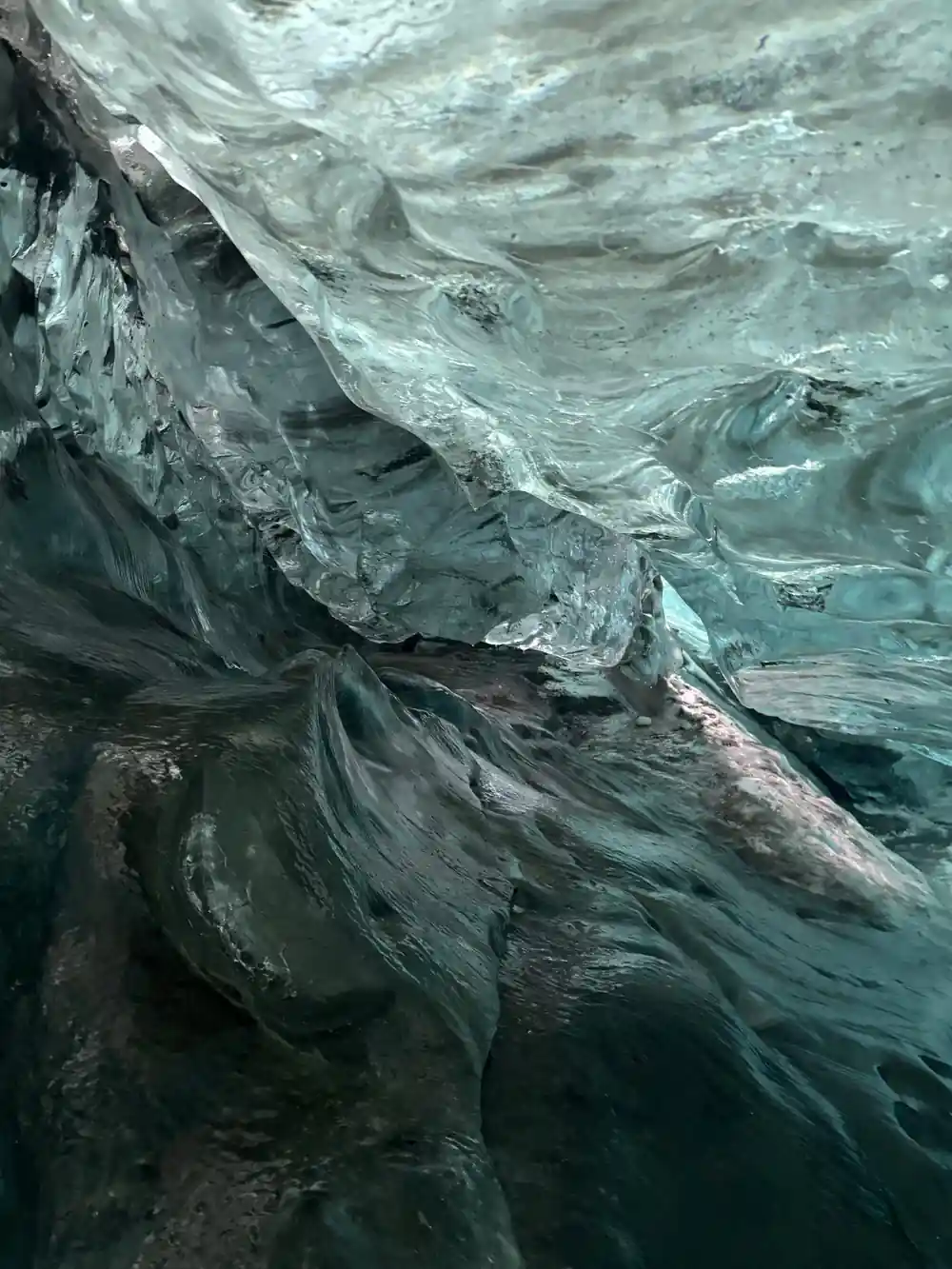
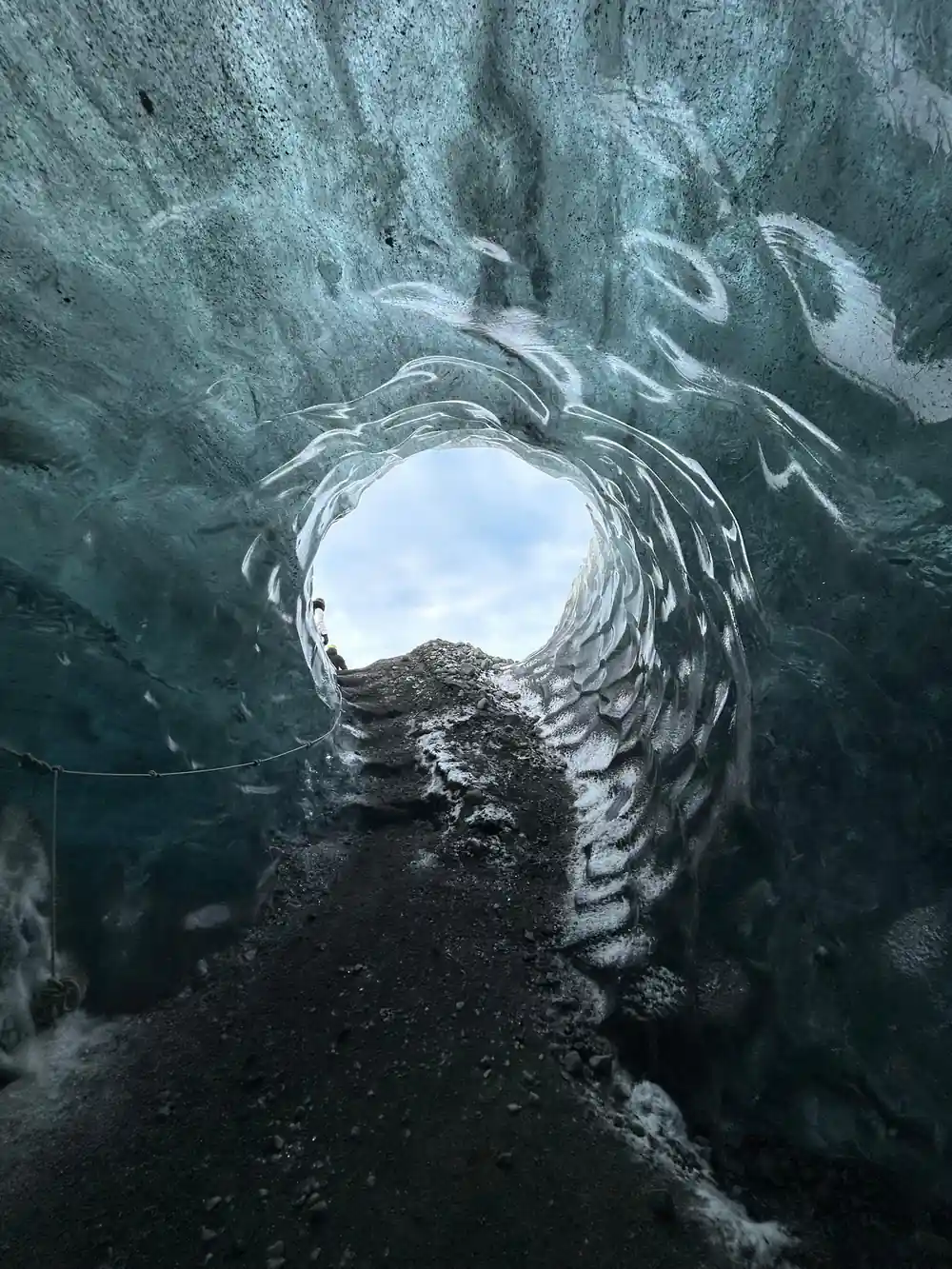
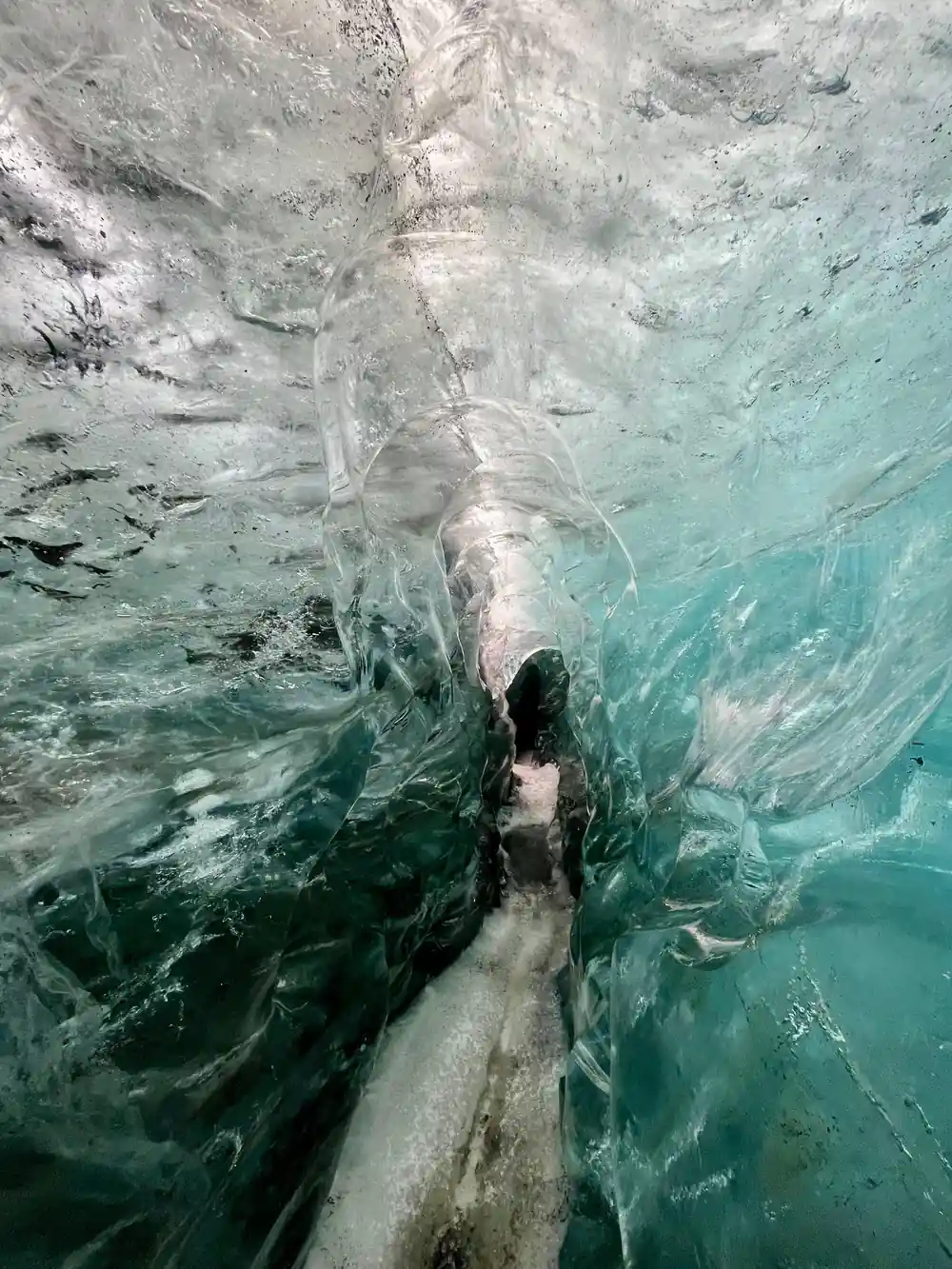
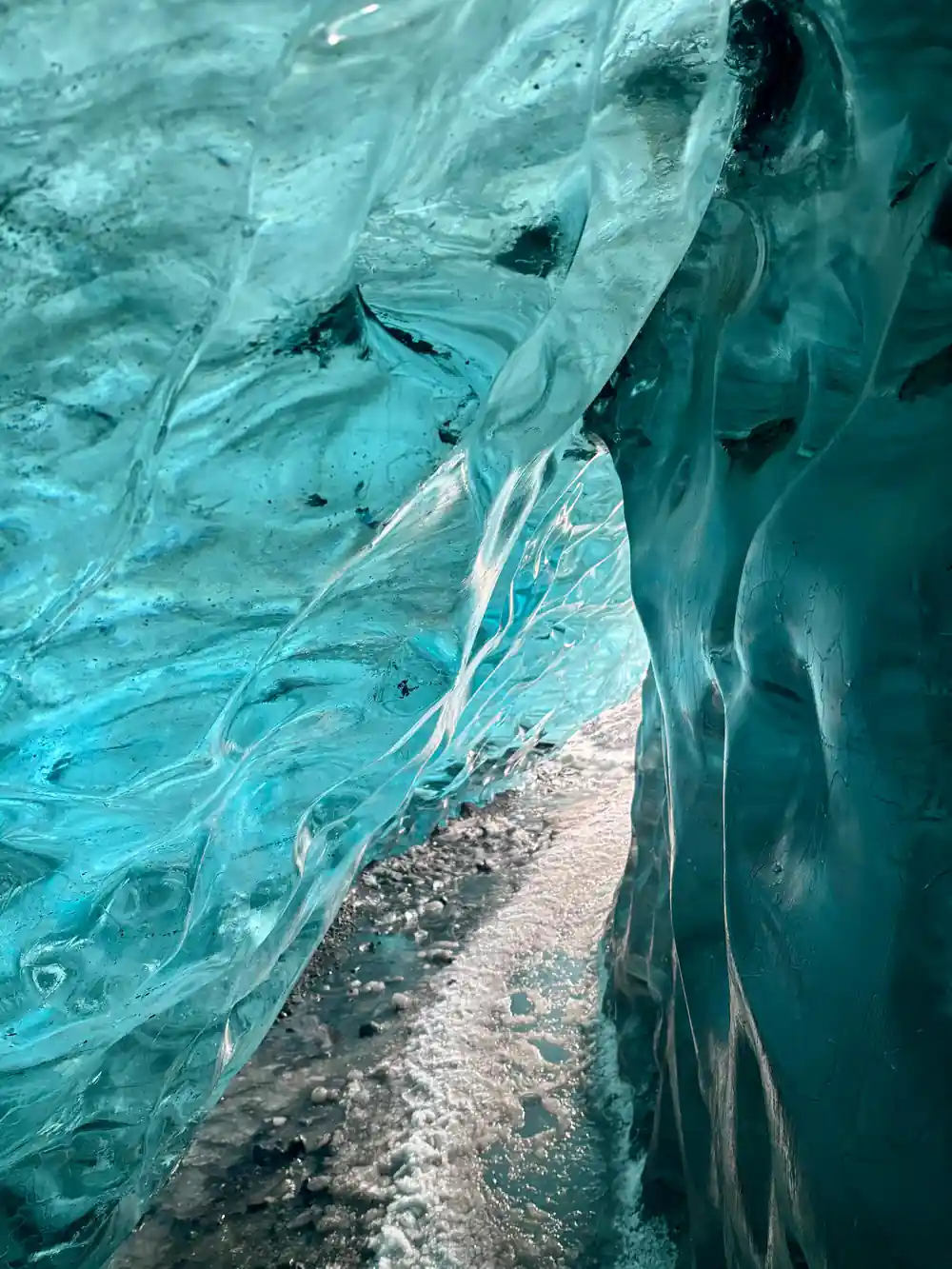
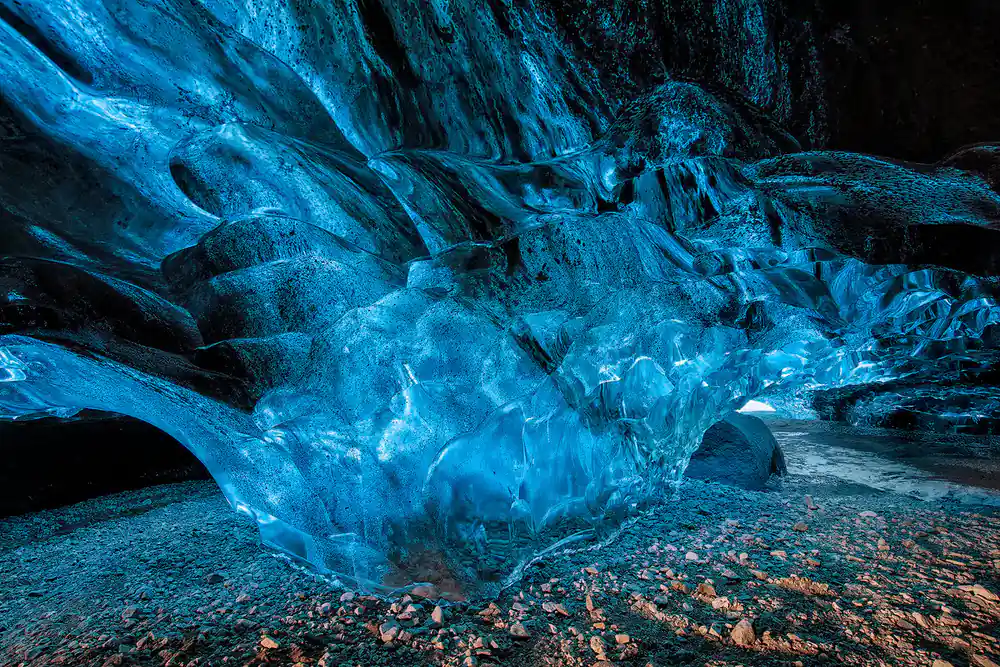
Blue ice inside a Vatnajökull cave, shaped by meltwater the summer before.
The Jökulsárlón ice cave under Vatnajökull
The tour booked from this site is the Jökulsárlón: Vatnajökull Ice Cave Guided Tour. It runs 3 hours, from US$164, with a live English-speaking guide and a jeep transfer from the lagoon up to Vatnajökull National Park and back.[2] It is rated 4.25 from 2,171 reviews.[2] The day starts at Jökulsárlón rather than in Reykjavík, so you need your own way to the lagoon first.
Deep glacier ice looks blue. Light hitting the large, dense crystals in old ice is absorbed at long wavelengths and scattered at short blue wavelengths, which is what your eye picks up.[13] The ice above the lagoon calves from Breiðamerkurjökull, and some icebergs in Jökulsárlón are thought to be made of ice more than 1,000 years old.[12] A few of them drift out and wash up on the black volcanic sand of Diamond Beach.[14]
Prices and formats around the lagoon vary. A natural blue ice cave tour is listed from US$145 and rated 4.92 from 43 reviews; an original ice cave tour is from US$161 with 4.61 from 1,129 reviews.[3][15] If you want more time on the ice, a 6 hour glacier hike to a remote ice cave is from US$285 and capped at 8 participants.[16]
Getting there: Vík, Jökulsárlón and the drive from Reykjavík
Jökulsárlón is about 370 km (230 miles) from Reykjavík along Route 1, and the drive takes roughly 5 hours each way in good conditions.[17] A same-day return from the capital is a lot of driving. Vík sits between Reykjavík and the lagoon on the same road, and Katla tours from Reykjavík fit into a single day.
Multi-day options cover both caves. A 2-day south coast tour with a blue ice cave is listed from US$735 and rated 4.71 from 261 reviews; a 3-day winter tour with an ice cave is from US$956 and rated 4.81 from 208 reviews.[18][19] Pickup is included on both, with the details to check when you book.[18][19]
If you are driving from Reykjavík, the lagoon sits at the far end of a long day and rewards an overnight stop nearby. If you are already in Vík, the Katla cave is the natural pick for the next morning, and the lagoon can wait for the following day on the road east.
from US$164
The tour booked from this site runs 3 hours with a live English-speaking guide and a jeep transfer up to Vatnajökull National Park.[2]
When the ice caves are there, and what winter feels like
A natural ice cave in Vatnajökull lasts one winter. It forms in October, holds through April, and is taken back by returning meltwater in May.[7] The cave you visit is a meltwater channel that drains and firms up as the cold sets in, and no two winters look the same. Guides find a new cave each autumn, and what you walk into this year will not be there next year. If the cave itself is the point of your trip, plan inside the October to April window and treat a summer visit as a glacier walk instead.[7]
Winter in Iceland is cold but rarely fierce. Average temperatures sit around 32°F (0°C), and daylight runs from 4 to 5 hours in late December to about 21 hours by late June.[20] Short days mean you should aim for a cave slot in the middle of the light. Summer is busier at the lagoon: around 100,000 tourists visited Jökulsárlón in July during one of its busiest summers on record.[21]
Group size, tour length and price in the listings
Short jeep trips are the common format in both areas, from 2.5 hours on a Jökulsárlón crystal ice cave departure to 3 hours on the tour booked from this site and on a Vík Katla tour.[2][8][22] Longer trips add a glacier walk, such as 5.5 hours for an ice cave and glacier exploration tour from Jökulsárlón, or 6 hours for a remote ice cave hike capped at 8 participants.[16][23]
Group caps are worth checking before you book. One Vík departure is limited to 14 participants, one Jökulsárlón departure to 8, and another to 14.[1][9][24] Read the rating breakdown rather than the headline score: the tour booked from this site scores 4.6 for its guide, 4.4 for transportation and 3.8 for value for money.[2]
Booking terms are similar across these listings: free cancellation up to 24 hours in advance for a full refund, and reserve now and pay later.[2][4]
Kit, safety and the rest of the south coast day
A sturdy helmet is essential inside an ice cave, protecting against falling ice and low ceilings, and it is generally provided by the tour operator.[10] The rest is standard Icelandic winter kit: waterproof outer layers, warm mid layers, spare gloves, and boots with grip you can walk uphill in. Caves are damp, the floor is ice, and you will spend time standing still in the cold while your guide talks. Grip matters more than warmth on the ice, and a spare pair of gloves in your bag is never wasted.
There is more to see around the lagoon than ice. Harbour seals are the most common seal species in the Jökulsárlón area, swimming and feeding in the water.[25] The tidal inlet that became Jökulsárlón Lagoon was excavated during the last glacial advance, about 26,500 years ago.[26] The lagoon has also had a film career, appearing in A View to a Kill, Die Another Day and Lara Croft: Tomb Raider.[27]
From-prices of ice cave tours
Each value is the from-price in US dollars of a GetYourGuide listing:[3],[2],[4],[6].
What an ice cave seat costs from
US dollar from-prices of these GetYourGuide listings:[2],[3],[4],[6].
When to book an ice cave tour
Choosing your ice cave day
Pick your base
Decide where you are sleeping. Vík puts Katla close; the lagoon suits anyone already heading east along Route 1.[17]
Check the dates
Natural ice caves in Vatnajökull belong to the October to April season, so a summer visit means a glacier walk instead.[7]
Match the length
A short jeep trip fits a driving day; a longer glacier hike with a cave needs a full day out on the ice.
Look at group size
Listings state their caps, from 8 participants on some Jökulsárlón tours to 14 on a Vík Katla departure.[1][9]
Book with a refund option
The tour booked from this site offers free cancellation up to 24 hours in advance for a full refund.[2]
Book the Jökulsárlón ice cave tour from this site
from US$164Reserve now & pay later